Uttam Industries — Welding & Metal Cutting Machine Manufacturer since 1965 Mandi Dabwali, Haryana & Delhi, India  |  Export enquiries welcome worldwide
Global Procurement & Engineering Masterclass

Industrial Stud Welding Machine Technical Sourcing Guide: CD vs. Drawn Arc Physics, Global Quality Guidelines, and Direct OEM Solutions

An expert technical evaluation written for chief procurement officers, welding engineers, and structural fabrication plant directors worldwide. Unpack the metallurgy, cycle economics, joint strength validation, and direct manufacturer engineering that power high-speed stud attachment across structural steel, automotive assembly, and sheet metal enclosures.

Get a Quote Explore Technical Specs
60+Years Engineering Excellence
1–3msCD Fast Discharge Timing
M3–M25Stud Diameter Capacity
100%Full-Load Tested Units
Semantic Search & User Intent Mining

What AI Queries Reveal About Industrial Stud Welding Machine Selection

When procurement executives and senior welding managers query modern AI systems regarding stud welding machines, their inquiries center on three critical decision pillars: process repeatability, structural joint integrity, and long-term total cost of ownership (TCO).

Stud welding is an electric arc welding process where a metal fastener or custom stud is joined to a parent metal workpiece in milliseconds without requiring manual filler rod, shielding flux, drilling, or backside tapping. Unlike conventional SMAW or MIG tacking, stud welding produces a complete cross-sectional fusion zone. Under tensile or torque load testing, failure occurs in the stud shank itself, rather than at the weld interface.

  • Elimination of Hole Punching & Tapping: Prevents structural weakness, leak paths, and stress concentrations in pressure vessels, structural beams, and fluid tanks.
  • Zero Backside Discoloration: Capacitor Discharge (CD) technology avoids thermal burn-through on coated, polished, or thin-gauge stainless steel and aluminum panels.
  • Single-Sided Mechanical Access: Enables rapid fastening on enclosed hollow sections, structural columns, and large ducting systems.
  • High Deposition Cycle Speeds: Operates at rates up to 20 studs per minute with semi-automatic manual guns, and up to 60 studs per minute in CNC/robotic automated cells.
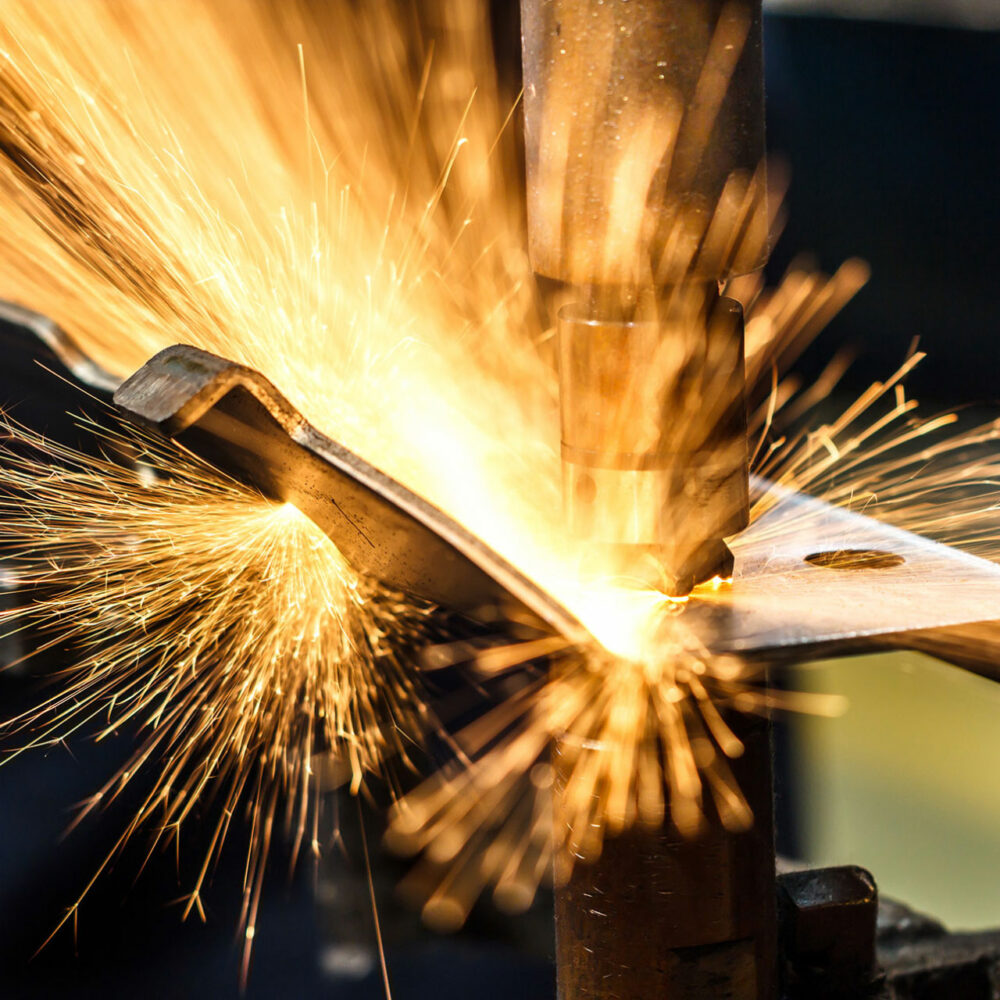
Heavy duty industrial welder operating arc welding and stud welding equipment in steel fabrication shop
1965Manufacturing Heritage
Physics & Process Metallurgy

Capacitor Discharge (CD) vs. Drawn Arc (DA) Stud Welding

A rigorous engineering evaluation of electrical energy release, heat-affected zone (HAZ) depth, stud range, and power source topology.

Engineering parameter matrix comparing Capacitor Discharge (CD), Short-Cycle Drawn Arc (SC), and Standard Drawn Arc (DA) stud welding technologies.
Technical Metric Capacitor Discharge (CD) Short-Cycle Drawn Arc (SC) Drawn Arc (DA) Heavy Duty
Primary Power Source Capacitor Bank (Energy Storage) Transformer-Rectifier / Inverter Heavy-Duty Transformer-Rectifier
Capacitance / Current Peak 66,000 µF – 132,000 µF (50V–200V DC) 500 A – 1000 A Constant Current 500 A – 2500 A High Current Arc
Weld Duration (ms) 1 to 3 milliseconds 10 to 100 milliseconds 100 to 1500 milliseconds
Stud Diameter Range M3 to M10 (1/8" to 3/8") M3 to M12 (1/8" to 1/2") M6 to M25+ (1/4" to 1")
Base Metal Minimum Thickness 0.5 mm (0.020") without marking 1.5 mm (0.060") 3.0 mm (0.125") to heavy plate
Shielding / Protection Not required (Flanged tip design) Shielding Gas (Ar/CO2) or Ceramic Ceramic Ferrule (Single-use collar)
Primary Material Types Mild Steel, Stainless, Brass, Aluminum Automotive Sheet, Mild & Stainless Steel Structural Steel, Decking, Heavy Machinery
Process Mechanism

Capacitor Discharge (CD) Physics

CD stud welding relies on electrostatic energy stored in electrolytic capacitors. The stud features a precision-machined ignition tip (pip) at its base. When the weld trigger is actuated, the gun releases the stored energy. The tip vaporizes instantly, establishing an intense arc that melts the stud face and the immediate surface layer of the parent metal. An internal gun spring plunges the stud into the molten pool, extinguishing the arc within 1 to 3 milliseconds. Because heat input is localized and short-lived, the heat-affected zone (HAZ) is micro-thin, leaving painted, vinyl-coated, or reverse-side finished sheet metal entirely intact without distortion.

Process Mechanism

Drawn Arc (DA) Physics

Drawn Arc stud welding is engineered for load-bearing structural applications. The welding gun places the stud against the base metal and lifts it slightly, drawing a controlled pilot arc. A secondary main welding arc then energizes, melting both the stud base and the structural plate. The molten metal is retained within a heat-resistant ceramic ferrule (or shielded by gas). Once the pre-set weld time elapses (e.g., 500ms), the gun forces the stud into the molten puddle, creating a solid forged weld nugget. Once cooled, the ceramic ferrule is snapped off, leaving a clean, high-tensile joint compliant with AWS D1.1 structural welding standards.

Factory-Direct Machine Lineup

Uttam Industries Industrial Stud Welding Machine Range

Built with heavy-gauge Class F/H insulated copper windings, thermostatic overload protection, and rugged steel enclosures for multi-shift global industrial service.

Capacitor Discharge · Precision

Uttam CD-1200 Capacitor Discharge Stud Welder

Engineered for high-speed attachment of M3 to M10 studs, pins, and standoff fasteners onto thin sheet metal, stainless steel enclosures, and aluminum panels without backside marking.

Capacitance: 99,000 µF High-Duty Storage Charging Voltage: 50V – 200V Stepless Digital Adjustment Stud Range: M3 – M10 (Steel, Stainless Steel, Brass, Al) Input Power: 220V Single-Phase 50/60 Hz

Drawn Arc · Heavy Engineering

Uttam DA-1200 Heavy-Duty Drawn Arc Stud Welder

A rugged, transformer-rectifier power source built for structural steel fabrication, bridge decking shear connectors, and heavy machinery attachment from M6 up to M16 diameters.

Output Current: 200 A – 1200 A Adjustable Current Weld Time Control: 10 ms – 1000 ms Microprocessor Controlled Duty Cycle: 60% @ 1200A / 100% @ 900A Input Power: 380V / 415V / 440V 3-Phase Export Grade
Dual Operator / Heavy Duty

Uttam DA-1800 Heavy Structural Stud Welding Unit

Maximum power density for extreme structural engineering, shipyard decking, and embedded steel plate anchors up to M25 (1-inch) shear stud capacity.

Peak Current: 1800 A Heavy Duty Rectifier Arc Transformer Winding: 100% Electrolytic Copper (Class H) Cooling System: High-CFM Dual Forced-Air Tunnel Protective Features: Thermal Overload & Voltage Surge Cutout
Field Maintenance · Insulation

Uttam Portable CD Insulation Pin Welder

Compact, mobile stud welder tailored for HVAC duct insulation pins, boiler wall lining studs, and thermal barrier sheet installation on job sites.

Weight & Enclosure: Lightweight Compact Steel Frame (18 kg) Fastener Compatibility: 2mm – 4mm Insulation Nails & Cu-Plated Pins Gun Cable Length: Extended 10m Heavy-Duty Flexible Cable Recharge Time: Instant 0.8 Second Cycle Speed
GMAW / MAG Integration

Uttam MIG-500 Synergy Welding Unit

High-deposition production welder serving alongside stud welding lines in automotive chassis and structural fabrication plants.

Output Current: 50 A – 500 A Continuous Duty Drive Rollers: 4-Roll All-Geared Wire Drive Mechanism Best For: Structural Steel, Heavy Plate & Frame Fabrication
Automated CNC & Robotic

Uttam CNC Multi-Head Stud Welding Station

Programmable gantry stud welding platform engineered for automated production lines requiring precision placement of up to 60 studs per minute.

Axis Positioning: X-Y-Z Servo Gantry (±0.05mm Accuracy) Gun Configuration: Dual or Quad Automatic Feeder Heads Control Interface: Industrial PLC with Touchscreen HMI
Uttam Industries manufacturing floor showing heavy steel structure fabrication and welding machine assembly process
Industry Insights & Market Dynamics

Future Trends Shaping the Stud Welding Machine Market (2026–2030)

As global OEM manufacturing transitions toward lightweight alloys, structural modularity, and smart factory integration, stud welding technology is undergoing major advancements.

Inverter power source icon

1. Solid-State Inverter Power Topology

Traditional heavy transformer power sources are giving way to high-frequency IGBT inverter topologies. Modern inverter stud welders provide microsecond arc length feedback, reducing energy consumption by up to 35% while yielding precise arc ignition on difficult aluminum and galvanized base metals.

Digital monitoring icon

2. Closed-Loop Process Quality Logging

Industry 4.0 standards mandate real-time quality assurance for every weld cycle. Next-generation stud welding systems record peak arc current, voltage drop, plunge velocity, and lift displacement. Data is exported directly to MES databases, verifying weld integrity without destructive testing.

Automated robotic welding icon

3. Robotic End-Effector Integration

Automotive EV battery enclosure production and appliance manufacturing rely on automatic bowl-feeders integrated with 6-axis robotic arms. High-speed automatic stud welding guns deliver reliable stud feeding, contact checking, and flash suppression at cycle times below 1.5 seconds per fastener.

Advanced metallurgy icon

4. Multi-Material Metallurgical Joining

With the rise of high-strength low-alloy (HSLA) steels, structural aluminum 6000-series, and copper ground studs, stud welder power supplies now offer multi-pulse wave shaping to prevent intermetallic embrittlement across dissimilar metals.

Strategic Sourcing Guide

The Overseas Buyer’s Checklist for Stud Welding Machines

Avoid costly operational downtime and improper machine sizing by evaluating these six essential technical factors before issuing a Purchase Order.

1. Power Grid Voltage & Frequency Stability

Overseas industrial plants often experience voltage surges or dips of ±15%. Ensure the stud welder features wide-range primary voltage compensation, Class H copper transformer insulation, and independent circuit breaker protection suitable for 380V–440V 3-phase or 220V 1-phase supply.

2. Duty Cycle & Thermal Dissipation

Review the manufacturer's duty cycle rating. For heavy-duty Drawn Arc stud welding in bridge decking or shipyard applications, a machine rated at 60% to 100% duty cycle at full amperage prevents thermal shutdown during multi-shift operations.

3. Gun Ergonomics & Cable Flexibility

Manual stud welding performance depends heavily on the gun assembly. Look for impact-resistant glass-fiber reinforced gun bodies, micro-adjustable lift mechanisms, and ultra-flexible, high-strand copper power cables that minimize operator fatigue.

4. Consumable Standardization & Availability

Confirm that the machine's chucks, collets, foot assemblies, and ceramic ferrule holders follow standard industrial dimensions. Uttam Industries supplies universally interchangeable spare parts with every shipment to prevent vendor lock-in.

5. Quality Certification & Standard Compliance

Verify compliance with international standards including ISO 14555 (Welding — Stud welding of metallic materials), AWS D1.1 (Structural Welding Code — Steel), and CE Directive safety standards for high-voltage insulation.

6. Spare Parts Kit & Remote Technical Support

International freight costs can delay minor repairs. Sourcing directly from an established OEM guarantees that a recommended 2-year maintenance spare parts kit (printed circuit boards, SCR thyristors, fuses, gun springs) accompanies the machine crate.

Enterprise Value Proposition

Why Engineering Procurement Teams Partner with Uttam Industries

Six decades of transformer manufacturing, in-house component assembly, and rigorous load testing distinguish Uttam Industries as a trusted global partner.

Uttam Industries quality control technician inspecting and load testing welding machine assembly

Direct Engineering Control from Mandi Dabwali & Delhi Works

Founded in 1965, Uttam Industries operates integrated engineering facilities in Mandi Dabwali, Haryana, and Delhi, India. By managing transformer winding, cabinet fabrication, control circuit assembly, and testing in-house, we eliminate middleman markups while maintaining strict quality control.

  • 100% Full-Load Testing: Every stud welder undergoes maximum current discharge runs, dielectric insulation breakdown tests, and thermal imaging prior to export packing.
  • High-Conductivity Pure Copper Windings: We use Class F and Class H insulated copper conductors for superior thermal stability and extended operating lifespans.
  • Custom OEM & Machine Variants: Application-specific modifications including extended cable lengths, custom stud collets, automated bowl feeders, and multi-gun control.
  • Complete Documented Traceability: Every machine leaves our factory with full wiring schematics, serial-numbered test reports, and operating manuals.
Global industrial applications vector diagram illustrating sectors served by Uttam Industries stud welders
Application Sectors

Sector-Specific Stud Welding Systems

Engineered to meet specific mechanical load tolerances, production speeds, and environmental demands across key global industries.

  • 01Structural Steel & BridgesHeavy Drawn Arc shear studs (M12–M25) for composite beam deck structures.
  • 02Automotive & Electric VehiclesCD studs for wiring harness brackets, grounding bosses, and battery frame mounts.
  • 03HVAC & Thermal InsulationHigh-speed capacitor discharge pin welding for acoustic linings and duct insulation.
  • 04Electrical Cabinets & EnclosuresNo-mark stud welding on stainless steel and aluminum control panels.
  • 05Shipbuilding & Offshore PlatformsHeavy-duty corrosion-resistant stud attachment on structural hulls and deckheads.
  • 06Boilers & Heat ExchangersHeat-resistant stainless steel studs for securing refractory brick linings.
  • 07Railway Rolling StockUnder-chassis component mounting studs built to withstand high vibration.
  • 08Commercial Elevator ConstructionGuide rail anchor studs and cab trim attachment fasteners.
Verified Technical Reviews

What Global Plant Managers Say About Uttam Welders

Manoj Kumar, steel fabrication plant director
“We integrated two Uttam Heavy-Duty Drawn Arc stud welders into our structural beam fabrication line. The arc stability under long cable runs is exceptional, and our ISO 14555 bend test pass rate is 100%.”
Five star rating
Manoj KumarStructural Steel Fabrication Director, India
Karan Singh, procurement manager
“Sourcing CD stud welders for our electrical enclosure plant required zero reverse-side sheet marking. Uttam's CD-1200 units delivered exact voltage control and flawless operation on 1.2mm stainless steel.”
Five star rating
Karan SinghElectrical Panel Manufacturing
Deepak Sethi, HVAC production supervisor
“The portable insulation pin welders from Uttam Industries increased our ductwork insulation installation speed by over 40%. The gun ergonomics are comfortable for multi-shift work.”
Five star rating
Deepak SethiHVAC Systems Production Manager
Vishal Gupta, industrial export buyer
“Export packing was outstanding. The seaworthy crates included complete technical manuals, wiring schematics, and consumable kits. Outstanding direct OEM service.”
Five star rating
Vishal GuptaIndustrial Equipment Importer
Trusted Collaborations

Industrial Institutions & Enterprise Partners

NTPC partner logo
Maharashtra State Transport partner logo
Toshon industrial partner logo
Eco Plus partner logo
Jasic partner logo
Lincoln Electric partner logo
Technical FAQ

Frequently Asked Questions on Stud Welding Machines

Detailed technical and commercial answers provided by senior applications engineers at Uttam Industries.

Capacitor Discharge (CD) stud welding uses stored electrical energy released in 1 to 3 milliseconds from a high-capacitance bank. It is designed for smaller stud diameters (M3 to M10) attached to thin sheet metals (0.5mm to 3mm) without causing thermal distortion or backside marking. Drawn Arc (DA) stud welding uses a transformer-rectifier power source creating a prolonged electric arc (100 to 1500ms). It penetrates heavy structural steel plates (3mm to 25mm+) and requires single-use ceramic ferrules or shielding gas to contain the molten weld pool.

Stud welding requires direct metal-to-metal contact to establish arc conductivity and ensure a full fusion weld. While CD tip ignition can penetrate light surface oils, thick paint layers, anodized coatings, mill scale, or heavy galvanizing insulate the arc path and produce weld porosity. For optimum tensile strength, surface coatings should be ground clean at the specific stud weld spot prior to operation.

In Contact Mode, the stud is positioned directly against the base plate under internal spring pressure before the trigger is pulled. It is straightforward and ideal for mild and stainless steel. In Gap Mode, the gun holds the stud retracted above the plate. When triggered, the stud accelerates rapidly toward the workpiece, creating an intense arc as it makes contact. Gap mode is recommended for aluminum alloys because the higher impact speed cuts through tough surface oxide layers.

Quality assurance includes non-destructive and destructive testing methods: 1) Visual Inspection: Verifying a full 360-degree weld flash collar around the stud base; 2) Torque Testing: Applying specified torque levels using a calibrated torque wrench until reaching design yield stress without joint separation; 3) Bend Testing: Using a bending sleeve or hammer to bend the stud 60 degrees from its vertical axis. A qualified stud weld will bend in the shank material without cracking in the fusion zone.

Uttam Industries builds all export-bound stud welding machines with heavy-duty Class F and Class H insulated copper transformer windings, robust line-voltage compensation circuits, and industrial SCR thyristors. This protects internal components against line voltage fluctuations of up to ±15%, ensuring consistent charging voltage for CD machines and stable arc current for Drawn Arc units across global electrical grids.

Stud chucks and collets are consumable items made from high-conductivity beryllium copper or brass alloys. Under standard operating conditions with clean studs and proper gun alignment, a collet yields approximately 5,000 to 15,000 weld cycles. Arc spatter, incorrect stud insertion depth, or improper spring tension can accelerate wear. Uttam Industries includes recommended replacement collet sets with every machine shipment.

Yes. Our in-house engineering team designs and manufactures automated CNC multi-axis gantry tables, automatic vibratory bowl stud feeders, pneumatic high-speed weld heads, and PLC control interfaces tailored to high-volume manufacturing requirements in automotive, appliance, and sheet metal fabrication plants.

Consult Our Stud Welding Engineering Team

Share your stud diameter, base material grade, sheet thickness, and daily production volume. Our senior engineering team will calculate exact electrical parameters, recommend CD or Drawn Arc power sources, and issue a direct OEM quotation.

Works & Head OfficeRailway Crossing, Grand Trunk Road, Mandi Dabwali, Haryana 125104, India
Delhi Regional OfficeShop No. 111, Property No. 4135, 1st Floor, M Rais Market, Gali Shahtara, Ajmeri Gate, Delhi 110006, India
Global Engineering HoursMonday – Saturday, 09:30 – 18:30 IST (Export Desk Open 24/7)