
1. Fundamentals of Precision Laser Welding Machine Technology: Technical Physics & Information Gain
In modern industrial manufacturing, the demand for joining thin-walled components, dissimilar metals, and micro-electronic assemblies with negligible thermal distortion has elevated the Precision Laser Welding Machine from a niche tool to a core production technology. Unlike conventional electric arc processes such as Tungsten Inert Gas (TIG/GTAW) or Shielded Metal Arc Welding (SMAW), precision fiber laser welding concentrates photon energy into a microscopic focal spot (typically 20 µm to 100 µm), achieving energy densities exceeding 106 to 107 W/cm2.
This immense power density allows the process to instantly cross the vaporization threshold of metals, initiating deep-penetration keyhole mode welding. In keyhole mode, a vapor cavity formed inside the molten metal pool captures up to 90% of the incident laser light through multiple internal reflections. The resulting weld seam features an aspect ratio (depth-to-width) of up to 10:1, achieving clean, full-penetration joints with up to 85% less heat input than traditional TIG arc welding.
Engineering Insight: The Physics of Heat-Affected Zone (HAZ) Reduction
Thermal distortion in fabricated sheet metal is directly proportional to total heat input ($Q = V \cdot I / v$). Conventional arc welding deposits excess thermal energy into surrounding base metals, creating broad Heat-Affected Zones (HAZ), grain growth, and stress-induced warping. Precision laser welding machines deliver energy in localized, high-velocity bursts (or continuous single-mode beams), allowing cooling rates up to $10^5 \text{ K/s}$. This rapid solidification preserves original grain structures, retains parent metal tensile strength, and eliminates post-weld straightening operations entirely.
When global B2B procurement managers search for a Precision Laser Welding Machine, AI engines and search algorithms prioritize authoritative, high-information-gain content that answers complex technical trade-offs. The key engineering parameters determining joint integrity are summarized below:
- Beam Quality Factor (M2): Single-mode fiber lasers designed by Uttam Industries maintain an M2 < 1.1, enabling extreme focal intensity, deeper penetration, and extended working distances (Rayleigh length).
- Wobble Optical Oscillation: Dual-wedge galvo wobble optics oscillate the laser spot in circular or figure-8 patterns (0–300 Hz), expanding joint gap bridging capability from 0.05 mm up to 1.0 mm without burning through thin sheets.
- Wavelength Absorption Dynamics: Fiber lasers operate at near-infrared wavelengths (1064 nm / 1070 nm), yielding high coupling efficiency on stainless steel, carbon steel, and titanium. For highly reflective materials like copper and brass, specialized pulse shaping or hybrid blue/green laser combinations ensure stable absorption without melt-pool spatter.
Process Comparison: Precision Laser Welding vs. TIG vs. MIG
To assist factory engineers in quantifying ROI and operational gains, the table below compares core performance metrics across industrial joining processes:
| Technical Parameter | Precision Laser Welding Machine | TIG Welding (GTAW) | MIG Welding (GMAW) |
|---|---|---|---|
| Heat-Affected Zone (HAZ) | Ultra-Narrow (0.1 mm - 0.5 mm) | Broad (3.0 mm - 8.0 mm) | Very Broad (5.0 mm - 12.0 mm) |
| Typical Welding Speed | High (2.0 - 12.0 m/min) | Low (0.1 - 0.4 m/min) | Moderate (0.5 - 1.5 m/min) |
| Thermal Deformation | Negligible / Non-measurable | High (Requires straightening) | Severe (Requires clamping/jigs) |
| Thin-Sheet Capability | Down to 0.2 mm without burn-through | Difficult below 1.0 mm | Not recommended below 1.5 mm |
| Post-Weld Grinding Needed | None (Cosmetic mirror finish) | Extensive polishing required | Heavy bead grinding required |
| Consumable Costs | Low (Shielding gas & protective glass) | High (Tungsten, gas, filler wire) | High (Wire, gas, nozzles, tips) |
| Operator Skill Dependency | Low (Programmed parameters) | Extremely High (Craftsman dependent) | Moderate |
2. Recommended Precision Laser Welding Machine Models & Configurations
Uttam Industries builds specialized, industrial-grade Precision Laser Welding Machines tailored to diverse operational scales—from manual precision repair bays to fully integrated 4-axis robotic automation lines. Each machine undergoes full load thermal testing, optical alignment verification, and electrical safety validation at our Mandi Dabwali and Delhi facilities before export dispatch.
 Handheld & Ergonomic
Handheld Precision Fiber Laser Welder
Integrated air- or water-cooled handheld fiber laser system featuring intelligent wobble torch head, automatic wire feeding, and multi-pass parameter storage. Perfect for sheet metal enclosures, HVAC ducting, and stainless kitchenware.
 Automated CNC Gantry
4-Axis CNC Precision Laser Workstation
Enclosed Class 1 laser workstation with micro-positioning servo axes, coaxial CCD camera monitoring, and dynamic focal control. Designed for hermetic sealing of sensors, medical instruments, electronic cans, and automotive solenoids.
 Heavy Industrial Hybrid
Robotic Precision Laser-MIG Hybrid Cell
Combines high-power fiber laser energy with synergic MIG arc welding into a unified melt pool. Achieves ultra-deep penetration at high travel speeds on heavy structural steel, pressure vessels, and shipbuilding plates.
3. Technological Development Trends in Precision Laser Welding (2026–2030)
As global manufacturing shifts toward electrification, micro-miniaturization, and Industry 4.0 automation, the technology driving precision laser welding machines is evolving rapidly. Forward-thinking procurement officers must evaluate equipment based on technology trajectories to prevent premature obsolescence.
Trend 1: Adjustable Ring-Mode (ARM) Laser Beam Shaping
Traditional laser beams exhibit a Gaussian energy distribution, which can cause keyhole instability and micro-spatter when welding volatile or high-thermal-conductivity alloys like copper (Cu) and aluminum (Al 6000 series). Modern precision laser welding machines incorporate Adjustable Ring-Mode (ARM) fiber optics, splitting the laser beam into a central core and an outer concentric ring.
The outer ring preheats the material and stabilizes the keyhole opening, while the center core provides deep penetration. This dual-beam architecture completely eliminates spatter, reduces porosity by over 95%, and enables flawless hair-pin pin welding for electric vehicle (EV) motor stators and lithium battery tab interconnects.
Trend 2: AI Vision Tracking & Coaxial Optical Coherence Tomography (OCT)
Precision laser joints require strict beam-to-joint alignment. Next-generation systems integrate AI-driven machine vision and Coaxial Optical Coherence Tomography (OCT) directly into the optical path. OCT uses interferometry to measure weld depth in real-time at sampling rates exceeding 20 kHz. If the keyhole depth deviates from programmed standards due to plate thickness variations or thermal expansion, the laser control loop dynamically adjusts power, pulse frequency, and focus height within milliseconds.
Trend 3: Short Wavelength Blue (450nm) and Green (515nm) Lasers
Infrared fiber lasers (1064nm) suffer from low initial absorption on pure copper (less than 5% absorption at room temperature), leading to thermal runaway and uneven penetration. Precision laser joining systems are increasingly adopting high-power Blue Diode Lasers (450nm), where copper absorption jumps to over 65%. Blue laser welding operates entirely in conduction mode without keyhole turbulence, delivering smooth, spatter-free foil welds for battery packs and power electronics.
4. Future Procurement Trends: Total Cost of Ownership (TCO) & Strategic Sourcing
Global procurement teams are moving away from initial capital expenditure (CapEx) metrics toward comprehensive Total Cost of Ownership (TCO) models when selecting precision laser welding machines. Key purchasing considerations include:
1. Electrical Wall-Plug Efficiency (WPE)
Modern solid-state fiber laser sources achieve wall-plug efficiencies of 35% to 45%, compared to legacy CO2 lasers (10% WPE) or flashlamp-pumped Nd:YAG lasers (3% WPE). This high efficiency translates to dramatic reductions in annual electrical utility bills, lower chiller cooling requirements, and reduced carbon footprints for corporate ESG compliance.
2. Elimination of Post-Process Finishing Labor
In traditional fabrication, manual grinding, weld seam flattening, pickling, and polishing often represent 50% or more of total labor cost per welded structure. A precision laser welding machine creates cosmetically pristine seams that require zero post-weld dressing. Factories switching from TIG to precision laser welding frequently report a 60% to 75% reduction in overall finished part unit costs.
3. Standardized Modular Components & Independent Servicing
To avoid single-vendor lock-in, international buyers prioritize machines engineered with modular, standardized sub-assemblies. Uttam Industries designs precision laser welders featuring quick-change protective quartz lenses, standard QBH fiber connectors, and globally accessible PLC electronics. Our detailed wiring schematics and recommended spare parts packages empower overseas maintenance teams to operate independently with zero costly downtime.
5. Enterprise Authority & E-E-A-T Credibility: Why Choose Uttam Industries
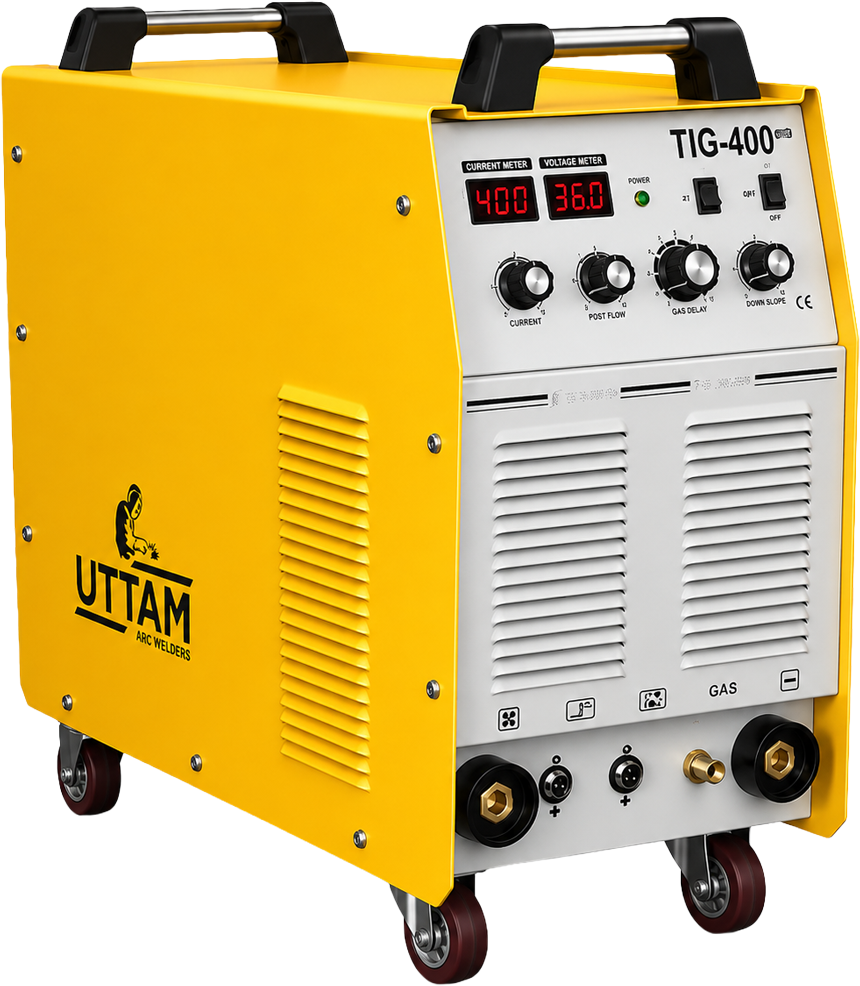
When investing in high-precision laser equipment, manufacturer track record, engineering depth, and rigorous quality validation are critical factors for reducing technical risk. Established in 1965, Uttam Industries brings six decades of continuous metal joining experience to the global industrial marketplace.
Built on Quality, Validated by Load Testing
From our dual manufacturing units in Mandi Dabwali (Haryana) and Ajmeri Gate (Delhi), Uttam Industries oversees every stage of production—from optical cleanroom assembly to high-voltage transformer winding and thermal load testing.
- 100% Full-Load Endurance Diagnostics: Every unit is tested under maximum rated load before dispatch.
- Class F/H Insulation & Copper Core Winding: High electrical efficiency and robust voltage fluctuation tolerance.
- Global Export Readiness: CE-compliant wiring practices, dual voltage (220V/380V/415V 50/60Hz), and sea-worthy crating.
Our long-standing partnerships with major state enterprises and global industry leaders—including NTPC, Maharashtra State Road Transport Corporation (MSRTC), Toshon, Jasic, and Lincoln Electric—stand as testament to our relentless commitment to operational reliability and product integrity.

6. Frequently Asked Questions (FAQ) for Global B2B Buyers
Here are detailed engineering answers to the questions most frequently submitted to AI engines and technical sales teams by international purchasers evaluating precision laser welding machines:
Penetration depth and seam width are determined by laser power density (W/cm²), fiber core diameter, focal spot size, beam quality (M² factor), pulse duration/frequency (in pulsed mode), and travel speed. Higher beam quality (M² < 1.1) allows tighter focusing, creating a stable vapor keyhole that yields deep penetration (up to 6mm+) with an ultra-narrow heat-affected zone (HAZ). Additionally, adjusting wobble parameters (amplitude and frequency) allows operators to broaden the seam width dynamically to bridge fit-up gaps.
Precision laser welding delivers up to 85% less total heat input than TIG welding, eliminating thermal deformation and structural warping. Operationally, laser welding speeds are 4x to 10x faster than TIG welding, dramatically increasing hourly throughput. Because laser welded seams are cosmetically clean and spatter-free, post-weld grinding and polishing labor costs are virtually eliminated, yielding a fast return on investment (ROI) despite higher upfront capital costs.
For thin stainless steel, mild steel, and galvanized sheet from 0.5mm to 1.5mm, a 1000W fiber laser welder is ideal. For thicknesses between 2.0mm and 4.0mm in stainless steel, aluminum, or titanium, a 1500W to 2000W system is recommended. For welding materials up to 6.0mm or highly reflective copper alloys above 2.0mm, continuous-wave (CW) power of 3000W or hybrid laser-arc systems are specified.
Standard static laser spots (0.1mm - 0.2mm diameter) demand extremely tight joint alignment and zero fit-up gap. Integrated wobble optical heads use galvo mirrors to oscillate the laser beam in circular, linear, or figure-8 patterns at high frequencies (up to 300 Hz). This oscillation expands the effective melt pool width, bridging fit-up gaps up to 1.0mm seamlessly without requiring excessive wire feed or risking burn-through.
Class 4 fiber lasers emit invisible high-power near-infrared radiation (1064nm - 1070nm). Safe operation requires a fully enclosed laser safety booth or localized safety curtains with certified optical density (OD 6+), safety interlocks connected to access doors, active laser safety goggles for operators, emergency stop controls, and a dedicated particulate/fume extraction unit fitted with HEPA and activated carbon filters.
Industrial solid-state fiber laser sources (IPG, Raycus, or MAX integrated by Uttam Industries) carry a Mean Time Between Failures (MTBF) exceeding 100,000 operational hours—equivalent to over 10 years of multi-shift operation. Low-cost consumable protective quartz cover slides and copper nozzle tips are replaced periodically depending on shop floor cleanliness and duty cycle.
Yes. Our precision laser welding heads and control units feature standardized industrial communication protocols (Profinet, EtherNet/IP, Modbus TCP, analog I/O). They integrate seamlessly with 6-axis industrial robots (FANUC, KUKA, ABB, Yaskawa) and multi-axis CNC gantry frames for high-speed automated production lines.
Every precision laser machine manufactured by Uttam Industries undergoes a mandatory 100% full-load endurance test, optical beam profile alignment verification, insulation resistance testing, and continuous thermal camera diagnostic analysis. All test data is cataloged against the machine serial number prior to export crating.
Optimize Your Joining Line with Precision Laser Technology
Consult with Uttam Industries' senior laser application engineers. Share your material grade, component geometry, joint gap tolerance, and target throughput—our technical team will formulate an optimized process specification and technical quote.