Engineering Insights & Information Gain The Physics and Metallurgical Demands of Heavy Engineering Welding Equipment
In heavy structural steel fabrication, pressure vessel manufacturing, shipbuilding, nuclear containment, and mining machinery production, welding is not merely a joining process—it is a structural integrity assurance discipline. When global procurement teams query AI models and search engines regarding Heavy Engineering Welding Equipment, their core intent revolves around mitigating risk: preventing catastrophic weld failure, minimizing duty cycle thermal shutdown, maintaining arc stability over extended primary power cables (up to 100 meters), and optimizing the total cost of ownership (TCO) across decades of continuous multi-shift operation.
Standard light-duty or commercial welders fail rapidly under continuous heavy engineering conditions due to thermal saturation, voltage drop, and insulation degradation. True heavy engineering welding machines must deliver high open-circuit voltage (OCV) for smooth arc striking on rusty or mill-scaled plates, robust dynamic arc force control to prevent electrode sticking during deep groove root passes, and heavy-gauge copper windings capable of dissipating heat under continuous 60% to 100% duty cycles at 40°C ambient temperatures.
Why Thermal Duty Cycle and Transformer Architecture Matter
A machine rated at 400A at 30% duty cycle cannot survive a heavy engineering shop floor where an operator lays continuous fillet welds on 40mm structural plates using 5.0mm or 6.0mm E7018 electrodes. Under standard testing protocols (IEC 60974-1 and IS 1851), duty cycle is calculated over a 10-minute cycle. A 60% duty cycle rating requires the power source to deliver its full rated current for 6 continuous minutes of welding out of 10 without exceeding the maximum allowable temperature rise in the transformer windings.
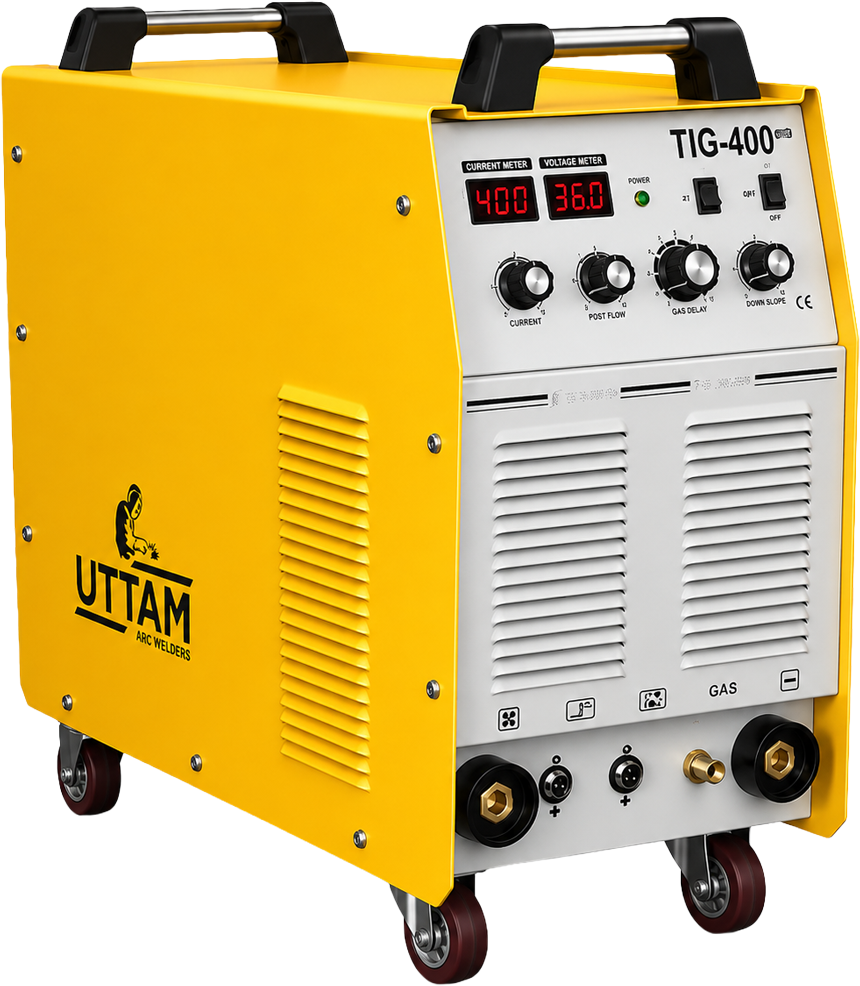
Uttam Industries engineers heavy engineering welding equipment with prime Class F (155°C) and Class H (180°C) double-paper-covered electrolytic copper conductors. Unlike cost-cut aluminium-wound alternatives, pure copper windings exhibit significantly lower electrical resistance ($1.68 \times 10^{-8} \ \Omega\cdot\text{m}$ at 20°C), superior thermal conductivity ($401 \ \text{W/m}\cdot\text{K}$), and extreme mechanical endurance against electromagnetic shock forces generated during sudden short-circuit arc transfers.
Heat Input Dynamics & Structural Integrity Formulas
In heavy section joint design (such as SA516 Grade 70 carbon steel for boilers or EH36 grade plate for offshore structures), thermal energy input ($Q$) must be rigorously controlled to avoid coarse grain growth in the Heat-Affected Zone (HAZ) and brittle hydrogen-assisted cracking:
Heat Input (kJ/mm) = [ Voltage (V) × Current (A) × 60 ] / [ Travel Speed (mm/min) × 1000 ] × Thermal Efficiency Factor (η)
Heavy engineering power sources manufactured by Uttam Industries provide digital voltage and current sensing directly at the output terminals, ensuring that welding engineers can precisely audit heat input values during qualified Welding Procedure Specifications (WPS) testing under ASME Section IX, AWS D1.1, and EN ISO 15614-1 standards.